

Most offices settle into a cleaning schedule almost by accident. Someone requests a quote, the provider suggests a frequency, and that arrangement quietly runs for the next three years. It works until it does not. The pantry starts to smell by Wednesday afternoon, or you realise that you are paying for five visits a week to a floor that sits half empty every Monday.
Choosing between daily office cleaning and a weekly service is less a budget question than an occupancy question. Get the frequency right and the office simply stays presentable without anyone thinking about it. Get it wrong in either direction and you either overspend or spend every week apologising for the state of the meeting room.
Key Takeaways
- Daily service runs about S$14 to S$25 per hour. Weekly and ad-hoc visits run S$20 to S$40 per hour, before 9% GST.
- Daily service costs about S$350 to S$550 a month for an office under 1,000 sq ft, and S$600 to S$900 for a mid-size office of 1,000 to 3,000 sq ft.
- If your washrooms sit inside your own unit, expect a noticeably higher quote. Washrooms and pantries are the most labour-intensive space in any office.
- Cleaner pay is set by law. From 1 July 2026 the minimum basic wage for an entry-level office cleaner is S$2,080 a month.
- Engaging an unlicensed cleaning company exposes you, the buyer, to a fine of up to S$10,000.
- Neither schedule covers carpets. In local humidity, carpets need professional extraction every three to six months.
Five Questions That Settle The Decision
Before comparing any quotes, answer these. Three or more “yes” answers point firmly to daily service.
- How many people are actually in the office on a typical day? Refer to the attendance instead of headcount. This is where imported advice tends to mislead. Hybrid working has not thinned out offices here the way it has in the West. Singapore attendance averages around 3.4 days a week, among the highest in Asia, and CBRE found that 43% of Asia Pacific companies hit peak utilisation of 80% or more, against 30% in the United States and 26% in Europe. If your floor is quiet on Mondays and Fridays, the better move is to align cleaning with your busy days rather than cut frequency outright.
- Do you clean your own washrooms? This single answer moves a quote more than floor area does. More on it below.
- Does the pantry see real food traffic? A kettle and a coffee machine is one thing. Thirty people eating lunch at their desks and rinsing containers in a shared sink is another, and it will not hold for a week.
- Do clients, candidates, or partners walk through your reception? A client-facing office has to look presentable every day it is open, not on average across the week.
- Are you in a hygiene-sensitive sector? Clinics, childcare, showrooms, and anything adjacent to food preparation carry expectations, and sometimes obligations, that a weekly visit cannot meet.
What a Daily Office Cleaning Service Covers
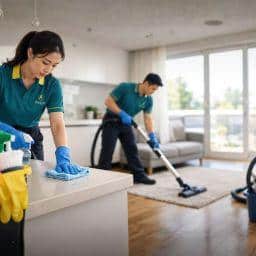
Daily visits are shorter than most people expect, usually one to three hours. That is the point. When soil never accumulates, each visit serves as maintenance rather than recovery.
- Bins emptied, desk surfaces wiped, floors vacuumed and mopped
- Pantry counters and sink cleaned, consumables restocked
- High-touch points cleaned and disinfected: door handles, light switches, meeting room controls, shared benches
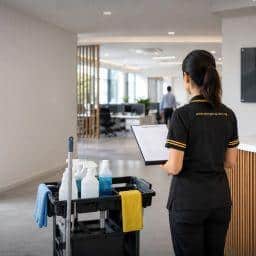
- Reception tidied to a presentable standard
- Washrooms, but only if they sit within your own unit
A daily office cleaning service also absorbs the minor problems that otherwise land on an office manager: the spill nobody reported, the empty hand soap, the overflowing recycling bin on a Thursday.
What Weekly Cleaning Covers, And Where It Falls Short
The task list is broadly the same. The interval is what changes the outcome.
In a busy office, every weekly session becomes a partial recovery clean rather than regular cleaning. Bins fill by midweek, the pantry sink builds up, and the office is only truly presentable for the day or two after each visit. You are still paying for high-quality work, but you are paying it to undo four days of accumulation instead of maintaining a clean environment.
Weekly service works for offices under roughly 15 people, with no food preparation, little walk-in traffic, and shared washrooms handled by building management. That is a real and common profile in Singapore, and those offices should not be talked into daily cleaning they do not need.
Who Cleans Your Washrooms? The Question That Changes Your Quote
In most multi-tenant buildings here, building management cleans the common areas and the common washrooms. That work is funded through the service charge, roughly S$1.10 to S$1.30 per square foot, and it is already sitting inside your gross rent. Your own cleaning contract covers the interior of your demised space and nothing beyond it.
This is why two offices of identical size can receive quotes hundreds of dollars apart. An office with washrooms inside its own unit is buying materially more labour than one down the road that uses common toilets in the lift lobby.
What Each Option Costs
Commercial cleaning in Singapore is quoted three ways: by the hour, by the square foot, or as a fixed monthly package. Most recurring office contracts settle on a monthly package, with a minimum of three to four hours per session.
| Basis | Typical range | Notes |
| Daily service, hourly | S$14 – S$25 per hour | Shorter visits, lowest hourly rate |
| Weekly or ad-hoc, hourly | S$20 – S$40 per hour | Higher rate, longer sessions |
| General office, per sq ft | S$0.10 – S$0.30 per session | Common for larger floorplates |
| Grade A CBD, per sq ft | S$0.28 – S$0.42 per month | After-hours access premiums apply |
Monthly Cost By Office Size
| Office size | Typical monthly cost |
| Under 1,000 sq ft | S$350 – S$550 |
| 1,000 – 3,000 sq ft | S$600 – S$900 |
| 3,000 – 10,000 sq ft | S$1,000 – S$2,000+ |
Figures are for a five-day service week. Grade A CBD space with restricted after-hours access commonly exceeds S$2,500. Scopes vary between providers, so confirm what is included before comparing quotes.
Weekly service is usually quoted from the hourly rate rather than as a size-banded package. At S$20 to S$40 an hour with a three-hour minimum, one visit a week works out to roughly S$260 to S$520 a month, and twice weekly to around S$520 to S$1,040.
That comparison produces the finding most office managers do not expect. For a small office, five visits a week can cost only a little more than one, because each daily visit is short. Daily cleaning costs less per hour than weekly cleaning, since a maintained office takes less time to service and the unit rate falls as frequency rises. The number that matters is total monthly spend, not the hourly rate on the quotation.
Two practical notes. Most headline “from S$X” prices exclude GST, so add 9% if the commercial cleaning service is GST-registered. And check how the hours are deployed, because one cleaner for four hours and two cleaners for two hours are priced similarly but produce very different results in a large space.
Why Cleaning Prices Are What They Are
Labour is the overwhelming share of any cleaning contract, and cleaner wages are not left to the market. The Progressive Wage Model sets a legal floor that rises every July.
| Effective from | Minimum basic monthly wage |
| 1 July 2025 | S$1,910 |
| 1 July 2026 | S$2,080 |
| 1 July 2027 | S$2,250 |
| 1 July 2028 | S$2,420 |
Employers must also pay an annual bonus of at least two weeks of basic wage. Read against those figures, a quote that falls well below the market is rarely a bargain. It usually means the wage floor is not being met somewhere in the chain, and that eventually becomes the buyer’s problem rather than the provider’s.
What Neither Schedule Covers
Relative humidity here is about 84% for most of the year, well above the 40% to 60% range at which interiors stay comfortable and dry. That accelerates mould in carpets and upholstery, feeds dust mites, and lets odours settle into sealed floors where the air conditioning recirculates the same air all day.
No amount of daily or weekly attention addresses this. Deep cleaning and periodic specialist work are outside both schedules and need to be budgeted separately.
| Task | Recommended frequency |
| Carpet cleaning (professional extraction) | Every 3 to 6 months |
| Upholstery and office chairs | Every 6 months |
| Window cleaning, internal glass | Quarterly |
| Air-conditioning servicing | Quarterly, usually the tenant’s responsibility |
| High-level dusting | Quarterly |
| Full deep cleaning | Every 3 to 6 months |
Most offices end up on a hybrid arrangement: regular cleaning on a daily or weekly cycle, with professional cleaning of carpets and hard surfaces scheduled each quarter.
One Check To Make Before You Sign
Every company offering commercial cleaning in Singapore must hold a valid NEA Cleaning Business Licence. Since January 2024 it runs in classes: Class 1 requires S$250,000 in paid-up capital and bizSAFE Level 3, Class 2 requires S$25,000 and the same bizSAFE certification. Ask for the licence number and class, and confirm it before signing anything.
Two optional signals worth asking about: Clean Mark accreditation, which is voluntary and awarded at Silver or Gold, and whether cleaning teams work to SS 694:2023, the current Singapore standard for measuring cleaning performance.
So, Which Is Right For Your Office?
| Choose | When this describes you |
| Daily | Over 20 staff on site most days, in-suite washrooms, an active pantry, client-facing reception, or a hygiene-sensitive sector |
| Weekly | Under 15 staff, common washrooms cleaned by building management, no food preparation, little walk-in traffic |
| Hybrid | Regular cleaning matched to your busiest days, plus quarterly deep cleaning. This is where most mid-size offices land |
The frequency that works is the one that matches how your office is used, not the one that looked cheapest on a comparison sheet. If you are unsure which side you fall on, a walkthrough with an experienced provider will usually answer it in twenty minutes. Avalon Services works with Singapore offices across both patterns and can scope daily, weekly, and periodic work against your existing lease obligations.
Frequently Asked Questions
How much does daily office cleaning cost in Singapore?
Roughly S$14 to S$25 per cleaner-hour, or about S$350 to S$550 a month for a small office and S$1,000 to S$2,500 or more for a large one. Add 9% GST if your provider is GST-registered. Office size, washroom responsibility, and building access hours drive most of the variation.
Is daily cleaning necessary for a small office?
Often not. An office under 15 people with no pantry cooking and landlord-cleaned common washrooms is usually well served by one or two visits a week, supported by a quarterly deep clean.
Who is responsible for cleaning the toilets, the tenant or the landlord?
In most multi-tenant buildings, building management cleans common washrooms and recovers the cost through the service charge. Washrooms inside your own unit are yours to clean. Check the provision in your tenancy agreement before you request quotes.
Is it cheaper to book daily or weekly cleaning?
Weekly usually costs less in total, but the gap is narrower than most people expect. Daily costs less per hour, because a maintained office needs less time per visit. In a small office, the two options can land within a couple of hundred dollars of each other each month. Compare monthly spend against the standard you actually need.
Does a cleaning company need to be licensed?
Yes. An NEA Cleaning Business Licence is mandatory for commercial cleaning services. Buyers who engage an unlicensed company are also liable, so ask for the licence number and class before signing.
How often should office carpets be cleaned?
Every three to six months. Humidity near 80% makes carpets hold moisture and odour far longer than in temperate climates, and annual cleaning is generally too infrequent to prevent mould.
Sources
- National Environment Agency, Cleaning Business Licence — https://www.nea.gov.sg/our-services/public-cleanliness/cleaning-industry/cleaning-business-licence
- Ministry of Manpower, Progressive Wage Model for the cleaning sector — https://www.mom.gov.sg/employment-practices/progressive-wage-model/cleaning-sector
- CBRE, 2024 Asia Pacific Office Occupier Survey — https://www.cbre.com/insights/reports/2024-asia-pacific-office-occupier-sentiment-survey
- Singapore Standards, SS 694:2023 measurement of cleaning performance — https://www.singaporestandardseshop.sg