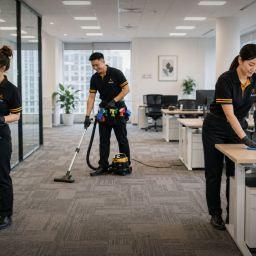
Many companies judge their office cleaning services by how the floor looks at 9 in the morning. The carpet has fresh vacuum lines. The pantry floor is dry. The lobby tiles are sparklingly clean.
The office space does look clean, visibly. But try asking yourself a different question. “How many people pulled the main door handle before lunch?”
In a 40-person office, probably all of them. Add the courier, a visiting client, and the aircon technician. That one handle gets more hand contact in a morning than most desks get all week, and it rarely gets a second look from the cleaning rota.
This is more important than it seems. Singapore’s Communicable Disease Agency (CDA) has said that periodic COVID-19 waves are expected throughout the year, as with other endemic respiratory diseases, and flu keeps circulating too. Shared surfaces are only one of the ways these viruses spread. But it is also where cleaning can make a practical difference. Unlike floors, these surfaces are touched repeatedly by many hands throughout the day.
This guide explains what office touchpoints are, why they belong at the top of your cleaning plan, and how to clean them properly.
Key Takeaways
- Germs on office surfaces move from person to person through hands. Door handles, lift buttons, light switches, and pantry handles are the main carriers.
- A touchpoint-first checklist puts high-touch surfaces on a daily cycle. Floors, carpets, and deep cleans run on their own schedules.
- Headcount and visitor traffic should decide how often touchpoints are cleaned, more than floor area does.
- Method is just as important as frequency: clean first, disinfect second, and give the disinfectant time to work.
What Is a Touchpoint in Office Cleaning?
A touchpoint is any surface that many different people handle during a normal workday. In office cleaning, the term covers door handles and push plates, lift buttons, light switches, printer panels, pantry fridge handles, water dispenser buttons, meeting room remotes, and shared keyboards.
What makes touchpoints tricky is that they usually don’t look dirty. A floor shows scuffs and footprints. A door handle, in contrast, can look spotless but, in reality, it contains traces from dozens of hands that have touched it.
That is why frequently touched surfaces get skipped. Cleaners and managers doing a quick walk-through both tend to judge a space by what they can see. Touchpoints subtly fail that test.
Why Touchpoints Deserve More Attention Than Floors
Floors collect dust and dirt, but nobody touches them all day. Hands are a different story. They pick up germs from one surface and carry them to the next. Worse, they may be carried to someone else’s face.
Evidence #1
The clearest proof comes from a University of Arizona study led by microbiologist Charles Gerba. His team placed a harmless tracer virus on one or two commonly touched surfaces, such as a doorknob or tabletop, at the start of the day in office buildings, a conference room, and a healthcare facility. Within two to four hours, the virus showed up on 40 to 60 percent of the workers, visitors, and commonly touched objects they sampled.
Two details from that study are worth pausing on. The first object contaminated was the break room coffee pot handle, and the office restroom was actually the least contaminated place in the building during the first two hours. The virus didn’t spread first where cleaning attention usually goes. It spread wherever people reached for their morning coffee.
Gerba put it simply: “The hand is quicker than the sneeze.”
Research Explains Why
Two more findings explain why this happens so fast. First, people touch their faces constantly. A University of New South Wales study found that participants touched their faces 23 times an hour on average, and 44% of those touches involved the mouth, nose, or eyes. Every contaminated handle is a short trip away from someone’s mouth.
Second, hard surfaces keep viruses alive longer. In a well-known laboratory study, influenza A and B viruses survived 24 to 48 hours on hard surfaces like stainless steel and plastic, but only 8 to 12 hours on cloth, paper, and tissues. Door handles, lift panels, and pantry taps are almost all steel or plastic.
Don’t Forget About Lift Buttons
A University of Toronto team found bacteria on 61% of the elevator buttons they swabbed, compared with 43% of toilet surfaces. That study was done in hospitals, and most of the bacteria found were not clinically relevant, so it is not a direct picture of an office. It does show which surface gets less attention than it deserves.
A Few More Multipliers
Offices in Singapore add a few multipliers of their own. Multi-tenant towers share lift lobbies, so one panel of buttons can serve workers from a dozen companies. Hybrid work also means more shared desks. In a 2024 MOM survey, 72.5% of private companies offered at least one type of scheduled flexible work arrangement. When desks are no longer assigned, one keyboard can pass through several pairs of hands in a week.
There is Good News
In the Arizona study, disinfecting wipes combined with hand hygiene cut the virus’s spread by 80 to 99 percent. Reducing the risk doesn’t take complicated equipment. It takes the right surfaces on the list.
What Should a Touchpoint-First Office Cleaning Checklist Include?
Organise the checklist by zone, not by task. Because if we do it by task (e.g., wipe surfaces), it would be vague, and the cleaner will just decide which surfaces count.
Refer to the table below for the touchpoints to include for each zone.
| Zone | Touchpoints to include | Suggested frequency* |
| Entrance, lobby, and lifts | Door handles, push plates, lift buttons, access card readers, reception counter | Daily; twice daily in high-traffic areas |
| Workstations and hot desks | Desk surfaces, keyboards, mice, desk phones, chair armrests | Daily for shared desks; weekly for assigned desks |
| Pantry | Fridge and microwave handles, kettle and coffee machine handles, taps, water dispenser buttons | Daily; twice daily if heavily used |
| Conference room | Table surface, chair armrests, remotes, conferencing screens, light switches | Daily, plus a quick wipe between back-to-back meetings |
| Washroom | Door handles, flush buttons, taps, soap and paper dispensers, cubicle latches | Daily or more, depending on headcount |
| Shared equipment | Printer and copier panels, shredder, stationery cabinet handles | Daily |
Please take note that these frequencies are only general guidance. Adjust them for headcount, number of visitors, and any illness in the office.
Pay attention to the spots that tend to be overlooked. For example, the inside edge of a pull handle, the basement button, the switch behind the meeting room door, and more. In the Toronto study, contamination levels didn’t differ by button location or by where the button was on the panel. There is no “safe” button, so every one should be wiped.
How Often Should Office Touchpoints Be Cleaned?
Once a day is the baseline for any shared surface. Busy offices need more. As one commercial cleaning provider notes, health authorities recommend at least daily cleaning and disinfection of high-touch surfaces, with more frequent rounds where customers or visitors come through all day.
Headcount is prioritised here, more than square footage. A small office with many staff can need more frequent touchpoint cleaning than a larger space that few people use. Hybrid offices should also adjust frequency based on peak office days, not just the total number of staff on payroll.
| Office profile | Touchpoints | Floors and general cleaning | Deep cleaning |
| Small office, high headcount | Twice daily | Daily | Quarterly |
| Large office, low occupancy | Daily | Daily or alternate days | Every six months |
| Hybrid office with hot desks | Daily, with extra rounds on peak days | Matched to attendance | Quarterly |
| Client-facing, high-visitor traffic | Twice daily or more | Daily | Quarterly |
Again, these are indicative ranges. The right schedule depends on your layout, occupancy, and whether anyone in the office is unwell.
Touchpoints belong to regular cleaning, meaning the daily and weekly rounds of cleaning. Carpets, upholstery, blinds, and air vents are periodic cleaning jobs with their own calendar. A deep clean doesn’t replace daily touchpoint work. It resets the parts of the office that daily cleaning cannot reach.
How Should Touchpoints Be Cleaned and Disinfected?
A quick wipe with a damp cloth removes smudges but it does not disinfect. Proper cleaning and disinfection take two steps in the right order, and the National Environment Agency (NEA) guidance for non-healthcare premises lays them out clearly.
- Clean first. A surface that is not properly cleaned beforehand won’t be properly disinfected, because germs stay behind. Remove grease and grime before doing anything else.
- Choose the right cleaning products. NEA lists hypochlorites (household bleach), chlorine-based products, hydrogen peroxide, alcohol-based disinfectants, and quaternary ammonium compounds (QUATs) among the common options. For surface disinfection, NEA suggests products such as diluted bleach or alcohol-based products with at least 70% alcohol.
- Spray directly onto the cloth. NEA advises this to avoid splashes that could spread pathogens further.
- Respect the contact (wet) time. The disinfectant needs to stay on the surface for the recommended time. Wiping it off straight away undoes the job.
- Work from clean to dirty. Use a steady wiping motion from cleaner areas to dirtier ones, and rinse or change cloths before moving to the next surface to avoid cross-contamination.
One detail in NEA’s guidance backs up everything above. Its recommended cleaning order runs from general waste to hard surfaces, dishes, and upholstered furnishings, with the floor and carpet last. Even the national guideline puts floors at the end of the job.
How Can Offices Keep Touchpoints Clean Between Cleaning Visits?
Cleaning teams handle the scheduled rounds. What happens in between depends on a few small habits.
Place hand sanitiser where hands meet shared surfaces
Lift lobbies, the pantry, and meeting room doors are the obvious spots. The Toronto researchers recommended placing alcohol-based sanitiser inside and outside elevators.
Put wipes at hot desks
Staff can wipe the keyboard and desk before and after use, which is extremely helpful in hybrid offices.
Step up during flu or COVID-19 waves
When CDA reports rising cases, add an extra midday round for lobby and pantry touchpoints.
Keep a simple log
NEA recommends keeping records of cleaning and disinfection activities. A sign-off sheet by the pantry door shows which touchpoints were done and when.
Clean What Hands Touch
Touchpoints determine whether an office is completely clean. Visitors may be impressed by sparkling floors, but properly cleaned office space is achieved when all surfaces are also disinfected.
Start by tweaking the cleaning checklist presented above according to your office requirements. You can add or remove some of the items that do not apply to your setting.
If your current rounds lean heavily on mopping and vacuuming, Avalon Services’ cleaning teams can build touchpoint rounds into your daily routine, plus periodic carpet and upholstery care if you require it.
Frequently Asked Questions
What are the most frequently touched surfaces in an office?
Door handles and push plates, lift buttons, light switches, pantry fridge and microwave handles, water dispenser buttons, printer panels, meeting room remotes, and shared keyboards. In the Arizona tracer study, the break room coffee pot handle was the very first object to pick up the virus.
How often should door handles and lift buttons be cleaned?
At least once a day in any office. Buildings with shared lift lobbies, heavy visitor traffic, or large headcounts should clean them twice daily, and more often during flu or COVID-19 waves.
Is cleaning the same as disinfecting?
No. Cleaning removes dirt and grime. Disinfecting kills germs. Touchpoints need both, in that order, with the disinfectant left on for its full contact time.
Do hybrid offices with fewer people on-site still need daily touchpoint cleaning?
Yes, on the days people are in. Shared desks mean more hands per surface. Schedule extra rounds for peak office days and lighter ones for quiet days.
What is the difference between regular cleaning and a deep clean?
Regular cleaning covers the daily and weekly work: touchpoints, bins, washrooms, and floors. A deep clean is periodic, usually quarterly or twice a year. It covers carpets, upholstery, vents, and the areas behind equipment that daily rounds do not tackle.
Sources
- University of Arizona tracer virus study, via ScienceDaily: https://www.sciencedaily.com/releases/2014/09/140908093640.htm
- Inside Science (AIP), “Doorknob Germs Can Infect Half The Office In Hours”: https://www.aip.org/inside-science/doorknob-germs-can-infect-half-the-office-in-hours
- Kandel et al., “Elevator buttons as unrecognized sources of bacterial colonization in hospitals,” Open Medicine: https://pmc.ncbi.nlm.nih.gov/articles/PMC4242253
- Kwok et al., “Face touching: A frequent habit that has implications for hand hygiene,” American Journal of Infection Control: https://www.ajicjournal.org/article/S0196-6553(14)01281-4/fulltext
- NEA, Guidelines for Cleaning and Disinfecting Premises (Non-Healthcare Settings) Exposed to Infectious Diseases: https://www.nea.gov.sg/our-services/public-cleanliness/environmental-cleaning-guidelines/guidelines/guidelines-for-cleaning-and-disinfecting-premises-(non-healthcare-settings)-exposed-to-infectious-diseases
- CDA, Update on COVID-19 Situation in Singapore: https://www.cda.gov.sg/news-and-events/cda-statement–update-on-covid-19-situation-in-singapore/