Office cleaning in Singapore is no longer a simple line item on the monthly expense sheet. In 2026, pricing is shaped by the Progressive Wage Model (PWM), the 9% GST rate, the rise of outcome-based contracts, and the growing adoption of cleaning robots and IoT sensors.
For small and medium enterprises (SMEs) trying to budget without compromising hygiene or compliance, understanding what drives the price is just as important as the price itself. This guide breaks down current rates, hidden costs, and ways to keep cleaning expenses predictable.
Key Takeaways
- A small SME office (under 1,000 sq ft) generally pays S$300 to S$800 a month for routine cleaning.
- The Progressive Wage Model sets a legal minimum wage for resident cleaners. Quotes priced below it are a compliance red flag.
- All GST-registered providers must charge 9% GST on top of the service fee.
- Shophouse offices tend to cost more per square foot than Grade A commercial offices due to access and waste-handling logistics.
- SMEs can offset technology and equipment upgrades through grants like the PSG and EEG.
What Drives Office Cleaning Costs in Singapore?
Several factors decide where an SME lands on the pricing scale. Office size and headcount are the starting points, but cleaning frequency, scope of work, property type, and required certifications all push the figure up or down. A 2,000 sq ft co-working office cleaned three times a week will cost very differently from a 2,000 sq ft medical clinic that needs daily restroom sanitisation and disinfection coatings.
Two cost drivers are unique to Singapore. The first is the Progressive Wage Model, which sets the wage floor for every resident cleaner working under a licensed firm. The second is the 9% GST rate, which applies to all GST-registered cleaning companies and was last adjusted on 1 January 2024. Both are non-negotiable, and both shape the lower bound of any honest quote.
How Much Does Office Cleaning Cost in Singapore?
The most common pricing format for SMEs is a monthly retainer based on office size and visit frequency. The table below summarises typical ranges across office sizes commonly found in CBD towers, business parks, and shophouse districts such as Tanjong Pagar and Telok Ayer.
| Office Size | Headcount | Frequency | Monthly Cost (SGD) |
| Under 500 sq ft | 1–5 | 1–2x weekly | S$300–S$500 |
| 500–1,000 sq ft | 5–15 | 2–3x weekly | S$400–S$800 |
| 1,000–3,000 sq ft | 15–40 | 3x weekly | S$500–S$1,300 |
| 3,000–5,000 sq ft | 40–70 | 3–5x weekly | S$800–S$2,000 |
| 5,000–10,000 sq ft | 70–150 | Daily (Mon-Fri) | S$1,200–S$3,000+ |
For SMEs that prefer flexibility, providers also offer per-square-foot and hourly pricing models. These are useful when the office is unusually configured, when cleaning needs vary week to week, or when ad hoc sessions are required.
| Pricing Model | Standard Range | Specialised Range |
| Per sq ft (monthly) | S$0.08–S$0.20 | S$0.15–S$0.35 (medical/F&B) |
| Per sq ft (deep clean) | S$0.15–S$0.30 | S$0.20–S$0.40 (post-renovation) |
| Hourly (part-time) | S$20–S$35 | S$40–S$90 (specialised/high-risk) |
| Hourly (daily cleaner) | S$14–S$25 | Varies by shift |
Why Are Some Quotes So Much Cheaper?
Quotes that look unusually low almost always cut corners on labour compliance. Under the PWM, basic monthly wages for resident cleaners rise on 1 July 2026. A general indoor cleaner moves from S$1,910 to S$2,080, a restroom cleaner from S$2,325 to S$2,495, and a supervisor from S$2,700 to S$2,870. These are baseline wages and do not yet include CPF contributions, the mandated PWM bonus (at least two weeks of basic pay per year), or overtime.
Once those add-ons are applied, the fully loaded labour cost sits roughly 25% to 40% above the basic wage. Any quote that implies a labour cost below this floor exposes the SME to legal risk under the National Environment Agency’s licensing framework, since both the buyer and the provider can face penalties.
A useful budgeting formula is:
Monthly Fee ≈ (PWM Wage × 1.4) + Material Costs + Management Fees + 9% GST
The 1.4 multiplier accounts for CPF, insurance, and the PWM bonus. Materials such as chemicals and bin liners typically add another 5% to 10% on top of labour.
Why Do Shophouse Offices Cost More Than Commercial Towers?
Property type plays a bigger role in cost than many SMEs expect. Heritage shophouse offices in districts like Joo Chiat or Telok Ayer often spread across two or three floors connected by narrow staircases. Without service lifts, cleaners spend more time moving equipment and supplies between levels, and waste removal usually relies on street-side or back-alley collection that private waste collectors charge more to navigate.
Grade A offices in buildings such as Suntec City or Mapletree Business City benefit from economies of scale. Cleaning is often integrated with broader facility management, including shared restrooms and centralised refuse handling. The trade-off is stricter access protocols (security clearance, bay bookings, and after-hours work permits), which providers fold into a management fee.
What Hidden Fees Should SMEs Watch For?
Beyond the headline rate, several charges can quietly inflate the monthly cleaning bill. These are the ones worth asking about before signing any contract.
- GST (9%) — applied to the full invoice if the provider is GST-registered.
- Specialised add-ons — carpet cleaning (S$150–S$400 per session, every 3–6 months), floor stripping and waxing (S$0.30–S$0.50 per sq ft), or 30-day antimicrobial coatings (S$265–S$420).
- High-rise window cleaning — exterior glass requires Working at Heights (WAH) certification, gondola permits, and minimum S$5 million public liability insurance. Hard water stains add S$10–S$30 per panel.
- After-hours and weekend surcharges — common in CBD buildings with restricted access windows.
- Waste disposal premiums — shophouse offices pay around S$32 a month for standard refuse collection, while bulky furniture disposal can run from S$40 for a single chair to over S$500 for a full office clearance.
A short pre-engagement checklist helps avoid surprises:
- Is the provider NEA-licensed?
- Does the quote separate labour, materials, GST, and management fees?
- Are PWM-compliant wages built into the rate?
- Are after-hours, weekend, and seasonal surcharges spelled out?
- What certifications (bizSAFE, ISO 41001) does the firm hold?
How Can SMEs Lower Office Cleaning Costs Without Cutting Corners?
There are three ways SMEs are reducing cleaning costs without sacrificing quality. The first is shifting from prescriptive contracts (paying for hours or headcount) to outcome-based contracts (OBC) under Singapore Standard SS 694:2023. OBC pays for measurable results (visual inspection scores, ATP microbial readings, surface pass rates), which lets providers redirect labour to where it is actually needed. For hybrid offices where Fridays are quiet and Tuesdays are full, this avoids paying for unused cleaning time.
The second is leveraging government grants. The Productivity Solutions Grant (PSG) supports up to 50% of the cost of pre-approved digital tools, capped at S$50,000 per firm over five years, and up to S$300,000 for advanced robotics. The Energy Efficiency Grant (EEG) covers up to 70% of energy-efficient equipment for SMEs, capped at S$30,000 in its base tier. Both are accessible to SMEs registered in Singapore with at least 30% local shareholding and either an annual turnover under S$100 million or fewer than 200 employees.
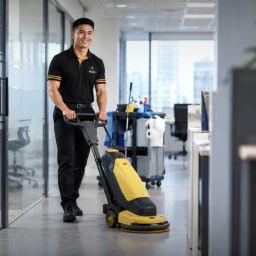
The third is adopting Robotics-as-a-Service (RaaS). Autonomous floor-cleaning robots can handle 70-80% of routine mopping and vacuuming, freeing human cleaners for high-touch surfaces. Subscription models eliminate the upfront capital cost, and IoT sensors for restrooms and meeting rooms allow demand-based cleaning instead of fixed schedules.
How to Choose an Office Cleaning Provider in Singapore
When comparing office cleaning services in Singapore, SMEs should look beyond price and focus on compliance, certification, and operational transparency. The criteria that matter most are NEA licensing, PWM wage compliance, bizSAFE certification (Level 4 or Star), ISO 41001 or 9001 accreditation, public liability insurance coverage, and clear communication channels for issue resolution. Providers that use digital inspection tools, IoT-based scheduling, or OBC frameworks tend to be more resilient to wage hikes, which means more stable pricing for the SME over the contract period.
Frequently Asked Questions
How much does office cleaning cost for a small office in Singapore?
A small office under 1,000 sq ft typically costs between S$300 and S$800 a month, depending on cleaning frequency. Single-visit shophouse cleaning generally starts at around S$200.
Is GST included in office cleaning quotes?
GST-registered providers must apply 9% GST on top of the service fee. Always confirm whether the quoted figure is inclusive or exclusive of GST.
Can I claim a government grant for office cleaning?
Routine cleaning services are not directly grant-supported, but SMEs can claim the PSG for cleaning robots and digital scheduling tools, and the EEG for energy-efficient equipment such as floor scrubbers.
Why is shophouse cleaning more expensive than office tower cleaning?
Shophouses usually have multiple floors, narrow staircases, no service lifts, and require street-side waste collection. These factors increase labour time and logistics costs.
How often should an office schedule deep cleaning?
Most SMEs schedule deep cleaning once a quarter, with carpet cleaning every 3–6 months. High-traffic offices or those in the food and healthcare sectors may need monthly deep cleaning.
Conclusion
Office cleaning in Singapore is shaped less by raw labour cost and more by how that labour is structured, regulated, and supported by technology. SMEs that understand the PWM floor, the 9% GST, and the property-type logistics behind a quote will spot pricing red flags faster and negotiate better contracts.
The smarter move is to treat cleaning as part of a facility strategy rather than a recurring expense to minimise.
For a tailored quote based on your office size, location, and frequency, Avalon Services can put together a costing aligned with your operations.
Sources
- Ministry of Manpower (MOM) — Progressive Wage Model wage schedule for the cleaning sector, July 2025–2027 — mom.gov.sg
- National Environment Agency (NEA) — Cleaning business licensing framework — nea.gov.sg
- Inland Revenue Authority of Singapore (IRAS) — GST rate change and transitional rules — iras.gov.sg
- Enterprise Singapore (EnterpriseSG) — Productivity Solutions Grant (PSG) and Energy Efficiency Grant (EEG) — enterprisesg.gov.sg
- Singapore Standards Council — SS 694:2023 Code of Practice for Environmental Cleaning — singaporestandardseshop.sg
Disclaimer: All cost figures in this article are indicative ranges based on publicly available data and prevailing market rates as of 2026. Actual pricing will vary by provider, scope, location, and contract terms. SMEs should request a tailored quote and verify current PWM, GST, and grant figures directly with the relevant authorities before making procurement decisions.
Last updated: May 2026