Caring for an ageing parent in Singapore often comes with questions that most families do not know how to answer. Do we need a helper, or do we need a caregiver? The two sound similar, but they serve very different purposes. And picking the wrong one can mean either overpaying for skills you do not need, or discovering that the person you hired cannot provide the care your elderly family member actually requires.
This guide helps you understand what each role covers, what they cost, and how to decide based on what your elderly member’s day really looks like.
Key Takeaways
- Part-time helpers cover household and daily living tasks; professional caregivers cover personal care and clinical needs.
- Part-time rates are $16-$30/hour; caregiver rates range from $23/hour for basic support to $100/hour for specialised nursing.
- The decision trigger is whether the elderly member needs help with three or more activities of daily living.
- Many families use both — a helper for the household, a caregiver for specific medical needs.
What Each Role Covers
The cleanest way to tell these two roles apart is through a simple framework used across elderly care services in Singapore: the difference between maintaining a home’s cleanliness and order and caring for a person.
Part-Time Helper
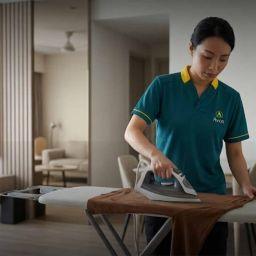
A part-time helper is usually in charge of keeping the home tidy and safe to move around in (i.e., performing tasks such as regular dusting, mopping, rubbish removal, and ironing). Other HSS-approved part-time domestic service providers offer basic elder-minding services like:
- assisting with personal care tasks for the elderly person,
- assisting with activities of daily living and instrumental activities of daily living (including feeding, lifting, positioning, and transferring the elderly person),
- engaging the elderly person in mind-stimulating activities and recreational activities,
- Assisting the elderly person in simple maintenance, and more (you can read the list of allowable tasks here)
What a part-time helper does not do is the clinical side of care. They are not trained to dress wounds, manage catheters, administer injection, or oversee medication schedules.
These tasks sit outside the scope of part-time helper services, and for good reason. A well-meaning helper attempting clinical work without training can cause real harm.
Professional Caregiver
A professional caregiver cares for the person, not the home. Their focus is hands-on support for the senior: helping with bathing, dressing, toileting, feeding, and transfers between bed and wheelchair. Depending on their qualification level, they may also administer medications, dress wounds, monitor blood pressure, or handle more specialised clinical tasks like catheter management, stoma care, or insulin injections. Many families also engage them as medical escorts for hospital visits.
Professional caregivers come in tiers. A basic caregiver handles personal care. A Health Care Assistant (HCA) adds simple nursing. A Registered or Enrolled Nurse handles specialised clinical work. Platforms like Homage, Jaga-Me, and CaregiverAsia connect families with professionals across these tiers on a pay-as-you-go or package basis. What they do not do is housework — no cleaning, no cooking for the family. Their time is reserved for the senior’s direct care.
| Who Does What
A part-time helper keeps the house clean and in order. A professional caregiver keeps the senior medically safe. If your parent/elder is relatively independent but needs help with housework and meals, a helper is the fit. If they need hands-on personal care or clinic oversight, a caregiver is the right choice. |
What Each Model Costs
The rates for both models have changed, driven by rising local wages under the Progressive Wage Model and the Local Qualifying Salary increase taking effect mid-year.
Part-Time Helper
Part-time helper rates generally range from S$16 to S$30 per hour. The rate you pay depends on the provider and whether you book recurring or one-off sessions. Recurring weekly or fortnightly bookings are consistently cheaper because providers can plan schedules ahead. Platform providers sit in the S$21–S$25/hour range for recurring bookings, with one-off sessions running S$24–S$30. Lower-cost options start from S$16–S$20/hour. Some providers include weekend and public holiday rates in their base pricing; others add a S$2–S$5/hour surcharge.
For a family booking four hours of help per week for an elderly household, the monthly cost lands somewhere between S$280 and S$520, depending on the provider.
Professional Caregiver
Professional caregiver rates are structured by qualification level rather than by provider. This is the main comparison that most families find useful when deciding how much care they actually need:
| Service Level | Weekday Rate | Night/Weekend Rate |
|---|---|---|
| Basic ADL Support (Caregiver) | S$23–S$28/hr | S$25–S$29/hr |
| Simple Nursing (HCA) | S$30–S$34/hr | S$32–S$36/hr |
| Specialised Nursing (RN/EN) | S$60–S$100/hr | S$80–S$120/hr |
| Medical Escort (per trip) | S$80–S$130 | S$100–S$150 |
One cost that families usually underestimate is the medical escort. When a senior needs transport to a specialist appointment (which for someone managing multiple chronic conditions might happen several times a month), a round-trip escort can cost up to S$130, including wait time. Over a year, those appointments alone can add S$1,500 to S$6,000 to the care budget.
To make the comparison concrete: twenty hours of care per week with a mid-range part-time helper costs roughly S$1,900–S$2,400 per month. The same twenty hours with a basic professional caregiver runs S$2,200–S$2,800. Step up to nursing-level care, and you are looking at S$2,800–S$3,500 for an HCA, or S$6,900 and above for a registered nurse.
What this tells you is that the gap between a part-time helper and a basic caregiver is narrower than most families expect. The gap widens sharply once nursing-level care enters the picture. For most families, the decision should rarely be driven by budget alone when the choice is between a helper and a basic caregiver.
How to Decide What Your Family Actually Needs
The budget is usually where families start, but it should not be where the decision ends. The better approach is to look at what the elderly member’s day actually looks like, then match that to the right service.
A part-time helper is the right fit when your parent is still largely independent (i.e., when they can bathe, dress, and feed themselves, move around the home without help, and manage their own medications). The gap you are filling is the home’s cleanliness and orderliness.
A professional caregiver and/or HSS-approved part-time domestic service provider offering basic elder-minding services becomes the right choice when the elderly member needs hands-on personal care. That includes help with bathing or toileting, support with transfers, or close monitoring of chronic conditions like diabetes, heart disease, or early-stage dementia. It also applies to the weeks after a hospital discharge, when recovery needs clinical oversight that a helper cannot provide.
Specialised nursing is a step further, which is reserved for situations involving wounds, catheters, feeding tubes, injections, or advanced dementia with behavioural management needs. This is no longer a helper-versus-caregiver question, but a clinical one.
So, which approach should I choose?
Many families find that a hybrid approach works best for their situation. A part-time helper can come three to four times a week to manage the cleanliness of the house, while a professional caregiver can handle weekly specialist visits or a monthly health review. The helper covers the volume of hours affordable, and the caregiver covers the skilled tasks that matter most.
This approach fits naturally into the broader ecosystem of home care services in Singapore. Families rarely need to pick just one model. They need to pick the right mix for the current stage of the elderly member’s needs, and adjust as those needs evolve.
Families whose loved ones are still largely independent but need a reliable helping hand with home cleaning would significantly benefit from engaging a part-time helper for elderly support. Providers like Avalon Services offer booking arrangements that allow families to scale hours up or down depending on circumstances, without the commitment of a full-time arrangement.
Frequently Asked Questions
What is the difference between a part-time helper and a caregiver for elderly care in Singapore?
A part-time helper is in charge of keeping the elderly’s house clean, though several HSS-approved part-time domestic services offering basic elder-minding services are available for elderly care.
A professional caregiver, on the other hand, provides personal and clinical care like bathing, medication management, and nursing tasks. In short, helpers focus on the home; caregivers focus on the senior.
Can a part-time helper bathe or feed my elderly parent?
Reputable part-time helpers are not trained for bathing, feeding, or other personal care tasks, and most agencies exclude these from their service scope. If your parent needs hands-on personal care, you can choose between a professional caregiver and a provider offering basic elder-minding services. The final decision will depend on whether you require basic or advanced elderly care.
Can I use both a part-time helper and a professional caregiver?
Yes, and many families do. A common arrangement can look like this: a helper comes three to four times a week for home cleaning, and a caregiver is available for medical visits or weekly personal care support. This kind of setup keeps costs manageable while covering domestic and clinical needs.
Sources
Ministry of Manpower — Household Services Scheme and Work Permit conditions
Homage, Jaga-Me, CaregiverAsia — professional caregiver rate benchmarks
Household Services Scheme–registered providers — part-time helper rates
Last updated: April 2026. The rates and figures in this article are estimates based on publicly available information at the time of writing. Actual costs may vary depending on the provider, frequency, scope of service, and any promotions. For the most accurate and up-to-date pricing, please check directly with the relevant platforms or agencies before making a decision.