We are living in a fast-paced corporate environment, and the cleanliness of your office can have a big influence on a client’s first impression. This puts office managers and business owners in a rather familiar problem. Should you handle cleaning in-house to cut costs, or hire a professional agency?
Many new businesses choose to start with a DIY cleaning approach. The most probable reason for this is because the team’s small. But as the company grows, it can be harder to maintain proper hygiene, which is why managers must decide whether simple cleaning solutions are still enough.
Let’s break down every factor involved in your choice for office cleaning.
Analysing the Internal Strategy
When we talk about DIY office cleaning in a corporate setting, we usually refer to two approaches: the Staff Roster system or the Direct Hire system.
Both of which grant the business owner full control but they also come with administrative burdens that often stay unseen until a problem shows up.
The Staff Roster Model
In smaller startups, it is common to assign cleaning duties to existing staff. A roster is created, and employees take turns clearing trash, vacuuming the carpet, and wiping down the pantry.
This approach does not add extra salary costs, true. But the opportunity cost can be quite big. When a business development executive or a lead developer spends 20 minutes a day taking out trash or washing mugs, you end up paying high-skilled salaries for low-skilled tasks.
Cleaning also tends to be pushed aside when deadlines are approaching. You would end up with unattended and overflowing trash bins, dirty skirtings, and a pest-infested pantry.
There is also the issue of proper knowledge. Most employees are not trained to use cleaning chemicals correctly. Many would try mixing a DIY cleaning solution they watched online such as vinegar and baking soda. These mixtures may not work against office germs. Or worse, they can even damage expensive office flooring and marble reception counters
The Direct Hire Model
The next level after a staff roster is hiring a dedicated cleaner directly under the company payroll. Several management staff would see this as a middle-ground option thinking you get a cleaner without paying an agency markup.
However, in Singapore, hiring a cleaner makes you a formal employer with full responsibilities under the Ministry of Manpower (MOM).
- You must pay the employer’s share of CPF. This is an additional cost to the base salary.
- You must buy Work Injury Compensation Act (WICA) insurance. If your cleaner slips on a wet floor, your company becomes responsible for medical claims and lost wages.
- You also need to manage annual leave, medical leave, and the Annual Wage Supplement (AWS), if required.
- On top of this, the office manager now becomes the procurement person. They must source detergents, restock toilet paper, and buy equipment like vacuum cleaners.
The biggest weakness of the direct hire model is the lack of backup. If your cleaner falls ill and gets a Medical Certificate (MC) for five days, cleaning operations stop completely.
There is no replacement. Your toilets go unwashed and trash continues to pile up, which forces the office manager to search for a temporary cleaner.
Outsourcing to Experts
Hiring a professional cleaning company transfers the responsibility from the business owner to a third-party provider. This industry is regulated by the National Environment Agency (NEA), the agency in charge of ensuring that licensed cleaning companies meet set standards.
Scope and Expertise
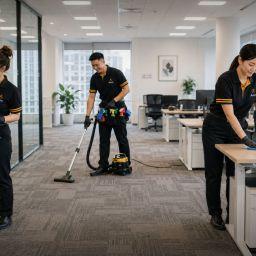
Professional cleaning covers more than just keeping the office tidy. This includes maintaining hygiene. A trained cleaning team follows a structured scope of work that usually includes high-dusting of AC vents and shelves, carpet care, and glass cleaning.
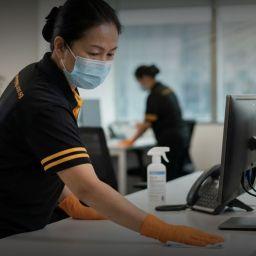
Most importantly, professional cleaners fully understand how cleaning chemicals work. They have access to commercial-grade cleaning solutions that can properly disinfect high-touch and low-touch surfaces without you worrying about material damage.
This level of care is important especially in the post-pandemic period. We care so much about surface hygiene, and now it’s an integral part of health and safety regulations in Singapore.
Equipment and Technology
A big advantage of outsourcing is access to industrial equipment. A basic vacuum that we would usually use at home is not enough for an office with a large carpet used daily.
Professional agencies bring HEPA-filter vacuums, floor scrubbers, and window-cleaning tools. Everything needed for proper cleaning is available, and there’s no need for capital expenditure. You do not have to buy, service, or replace any equipment. The agency handles them all.
Reliability and Manpower Coverage
Aside from effectiveness and efficiency of cleaning, the premium you pay for a professional service is mainly for reliability. Trusted cleaning agencies in Singapore have a pool of relief or ‘floater’ staff.
If your assigned cleaner falls sick or goes on leave, the agency is required to send a replacement. This only means zero downtime/continuous office cleaning — something the direct hire model cannot guarantee.
The Financial Comparison
Some businesses hesitate to outsource cleaning because of the cost. At first glance, a monthly invoice from a cleaning agency seems higher than the basic salary of a cleaner hired directly. But a proper financial analysis must consider the Total Cost of Employment.
Let’s look at an example: a typical SME office that needs daily cleaning for four hours a day.
The Cost of DIY
- Base Salary: Market rate for a cleaner
- CPF: +17% employer contribution
- Levy: Foreign worker levy (if applicable)
- Bonuses: AWS or performance bonuses
- Admin Costs: HR time spent processing payroll, handling claims, and managing disputes
- Supply Costs: Monthly spending on chemicals, bin liners, and equipment depreciation
- Risk Cost: Liability in case of workplace injuries
The Cost of Professional Services
- Monthly fee: A single flat rate
When all the unseen costs of the Direct Hire model are added up, you can see that the price difference is marginal. In many cases, professional cleaning becomes the more cost-effective choice because it gets rid of unpredictable expenses like equipment repairs and reduces the soft costs of management time and distraction.
Regulatory and Safety Considerations
Singapore has strict rules that govern the cleaning industry, and office managers must understand them to avoid legal issues that may arise.
NEA Licensing
Under the Environmental Public Health Act, all cleaning businesses in Singapore must be licensed by the NEA. When you hire a professional agency, you are assured that they are compliant with these regulations. If you attempt a DIY approach by hiring a freelance cleaner who does not have a valid business license or work permit, you expose the company to legal repercussions.
Progressive Wage Model (PWM)
The cleaning industry is subject to the PWM, which mandates wage floors and training requirements for cleaners. Professional agencies handle all PWM compliance, ensuring their staff are paid and trained according to government mandates. Managing this compliance internally for a single in-house cleaner can be administratively complex for a company that does not specialise in HR for manual labour.
Chemical Safety and Storage
Offices are enclosed environments with central air conditioning. The improper use of volatile chemicals can degrade Indoor Air Quality (IAQ), leading to staff complaints or health issues. Professional cleaners are trained in Safety Data Sheets (SDS) and know which cleaning solutions are safe for indoor use. Conversely, a DIY cleaning solution mixed without knowledge of chemical interactions (such as mixing bleach with ammonia-based products) can create toxic fumes, posing a severe health risk to your employees.
Critical Decision Factors for Management
If you are still on the fence, consider these three factors to guide your decision.
#1 – Office Traffic and Size
If you operate a small consultancy with three employees in a 400-square-foot service office, a quick DIY tidy-up or a weekly part-time helper is sufficient.
However, once an office exceeds 1,000 square feet or has more than 10 employees, the volume of waste and dust generated daily makes professional cleaning a necessity.
#2 – Client Impressions
Walk through your front door and look at your office as a client would. Are there coffee stains on the meeting room carpet? Is there dust on the reception counter? Are the glass doors streaky? In-house staff often become ‘nose-blind’ to these details.
Professional cleaners are trained to spot and rectify these aesthetic issues that impact your brand image.
#3 – Security and Liability
Professional agencies vet their staff. In an office environment filled with expensive laptops and confidential documents, security is paramount. While no system is foolproof, an agency provides a layer of accountability.
If an agency staff member is suspected of theft or misconduct, the agency has protocols to handle the investigation and replacement immediately.
With a direct hire, the burden of investigation and termination falls entirely on you.
Conclusion
The DIY route offers a perceived sense of control and initial cost savings, but it is rarely a scalable solution for growing businesses in Singapore. The hidden costs of manpower management, the liability of direct employment, and the inconsistency of cleaning standards often outweigh the monthly fee of a professional service provider.
For office management, the ultimate goal is operational efficiency. And this is achieved, in one way, by outsourcing cleaning to NEA-licensed office cleaners. You are paying for a clean office. You are purchasing consistency. And you have the freedom to focus on your core business activities without any distractions.