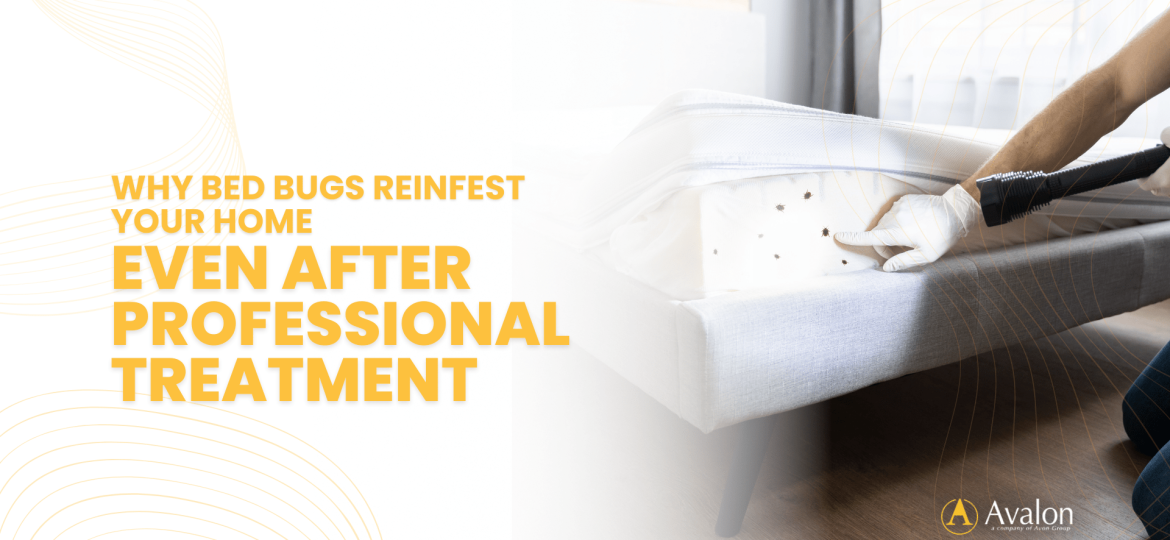
You did everything right. You stopped trying to fix it yourself. You called in professionals for bed bug treatment. You laundered your sheets. You paid for the service. For a few days, you were relieved thinking you could finally sleep soundly.
But then you noticed a tiny dark speck moving across the pillow, or found that cluster of bites on your arm. You get frustrated and ask yourself, “Am I not cleaning my house enough? Did the professional bed bug treatment fail? Or am I just unlucky?”
We tell you that this isn’t because of bad luck. These pests are just really difficult to eradicate because they have evolved to survive our attempts to kill them.
So if you’re struggling with bed bugs even after treatment, read through these mechanics of their survival. We will also share what needs to be done to break the cycle permanently.
The ‘Resurrection’ Effect
The most common reason for a sudden return of bed bugs (based on what you know) is that they never actually left the space. The infestation simply moved from one life stage to another.
To understand this, we must look at the biology of the bed bug (Cimex lectularius). A typical infestation consists of adults, nymphs (juveniles), and eggs. While it is true that bed bugs are vulnerable to most professional-grade insecticides, their eggs are a different story.
The Biological Bunker
Bed bug eggs are tiny — about 1mm in size, pearly white and usually hidden deep within the tightest cracks of a bed frame or mattress seam. Nature has designed these eggs to be incredibly resilient.
The shell of a bed bug egg is coated in a sticky substance that cements it to surfaces, making it impossible to vacuum up easily. More importantly, the shell acts as a biological bunker. It is not easily permeable.
Many standard chemical bed bug treatments work by contact. They kill the live bugs walking over the treated surface. However, liquid insecticides often cannot penetrate the eggshell to kill the developing embryo inside.
The Singapore Incubation Timeline
In cooler climates, bed bug eggs can take weeks to hatch. However, in a warm, humid tropical climate like Singapore’s, the incubation period is accelerated. Eggs here can hatch in as little as 6 to 10 days.
Here is a common scenario.
- Day 1: A pest controller sprays your room. The adults and nymphs die. The room seems clear.
- Day 5: The chemical residue starts to degrade or dry up.
- Day 8: The eggs that were hidden deep in a screw hole hatch.
- Day 15: You have a fresh population of hungry nymphs.
If your bed bug treatment plan involves only a single visit, or if the follow-up treatment is scheduled too late, you may witness the next generation emerging. This is why a one-and-done treatment almost never works for bed bugs.
The ‘Super-Bug’ Phenomenon
The bed bugs plaguing homes today are not the same bed bugs your grandparents might have dealt with. Over the last two decades, bed bug populations globally have developed a genetic mutation known as Knockdown Resistance (kdr).
Thicker Skin and Detox Enzymes
Modern bed bugs have evolved two distinct defence mechanisms against chemicals.
One, thicker cuticles. Their exoskeletons have become thicker and more waxy, making it difficult for contact poisons to absorb into their bodies.
Two, metabolic resistance. Even if the poison gets inside, resistant bed bugs produce enzymes that can detoxify or break down the poison before it kills them.
The Failure of Retail Sprays
This bug resistance is high against pyrethroids, or the class of chemicals found in almost every canister of bug spray you buy at the supermarket.
When a homeowner attempts to treat an infestation with these off-the-shelf products before calling a professional, they usually make the problem worse.
The spray might irritate the bugs; and they are not killed. The colony will only scatter from the bed where they are concentrated, into the walls, electrical sockets, and curtains.
Professional pest control services in Singapore use commercial-grade formulations that mix different modes of action to bypass this resistance. If your previous treatment relied on generic, low-grade chemicals, it is highly likely that the bed bugs simply walked right over them and survived.
High-Density Cross-Infestation
In Singapore, we live vertically. Whether you are in a BTO flat or a private condominium, you are physically connected to your neighbours by concrete, piping, and wiring. This reality is a major factor in persistent infestations.
Bed bugs are not limited by your front door. They are excellent hitchhikers, but they are also capable crawlers. In search of a blood meal or if they are escaping a bug bomb set off by a neighbour, bed bugs can travel through the following:
- The wiring gaps behind power sockets connect units
- The spaces around pipes in bathrooms and kitchens
- Bugs can crawl out from under a neighbour’s door and under yours
The Neighbour Dilemma
Even though you have treated your home perfectly, if the unit directly beside, above, or below you has a heavy infestation and they’re ignoring it, your home remains at risk. This is known as cross-infestation.
In these cases, spot treating just your bed is not enough. The treatment needs to include barrier protection along the perimeter of your rooms, focusing on skirting boards, entry points, and electrical outlets to intercept bugs migrating from adjacent units.
Accidental Re-introduction
Sometimes, the bed bug treatment was successful. The eggs were destroyed, the adults were killed, and your home was sterile. Yet a month later, they are back.
In this scenario, it’s possible that you are dealing with a new bug invasion. Humans serve as bed bugs’ vehicles. If the source of the initial infestation hasn’t been identified, you will keep bringing them home.
Here are the possible re-introduction points you can check:
- If your office has a bed bug problem (like in carpeted areas or cushioned chairs), you may be carrying a single female bug home in your laptop bag or on your trousers.
- Even 5-star hotels are not immune. If you travel frequently or enjoy weekend staycations, luggage is a primary vector. A bug crawls into the seam of your suitcase, rides home with you, and crawls out when you store the bag in your bedroom.
- Platforms like Carousell are excellent for bargains, but buying second-hand furniture especially bed frames, sofas, or even nightstands) is risky. A clean-looking wooden bed frame can house dozens of eggs in its joints.
- If you employ a helper who visits friends or stays at a dormitory on off days, there is a risk of them unknowingly bringing pests back.
Unless you identify where the bugs came from originally, you are trying to bail water out of a boat without plugging the hole in the hull.
Human Error in the Aftermath
Successful bed bug treatment is a partnership between the pest control provider and the homeowners. The technicians applying the treatment set the space for bed bug removal. The homeowner, on the other hand, should be proactive, because the full treatment doesn’t end with professional application.
The Clutter Problems
Bed bugs are thigmotactic (they love tight spaces). Clutter provides them with infinite safe harbours. Never ever leave your floor covered in piles of clothes, stacks of newspapers, or boxes stored under the bed.
If a technician cannot access the floor perimeter or the wall behind the bed, the treatment will be compromised.
The Laundry Misconception
Many homeowners wash their bedsheets but they forget to heat-treat them. Water alone may not kill all eggs.
Sunning is also not enough because the rays from the sun are not adequate to sustain the consistent temperature required to cook the eggs hidden in the thick seams of a mattress protector or duvet.
You must use a dryer on the highest heat setting for at least 30 minutes.
Skipping the Follow-Up
This is perhaps the most critical error. After the first treatment, visual activity usually drops by 90%. You would think that the problem is solved and may cancel the follow-up appointment to save money or time.
As discussed in point #1, the eggs will hatch a week later. Without that second, and sometimes third, treatment to catch the newly hatched nymphs, the infestation will fully recover within two months.
Conclusion
If you are facing a recurring bed bug issue, we remind everyone that, most often, it is not your fault. Reinfestation can happen anytime, particularly when the bed bug treatment strategy fails to account for the resilience of the eggs, the reality of chemical resistance, and noteworthy conditions of your home.
You need a scientific approach to tackle the bed bug problem at the source. Contact Avalon Services today for an inspection and treatment plan that we designed to work the first time.